
Oura Ring VO2 Max & Cardio Capacity Guide
See how Oura estimates VO2 max with Cardio Capacity, how the six-minute walking test works, where to find your score, and what high or low results mean.
A good Oura VO2 max is one in the High or Peak level for your age and sex. Oura reports VO2 max in ml/kg/min and places it in one of four levels: Low, Fair, High, or Peak. For example, a woman aged 30–34 reaches High at 36 and Peak above 42, while a man of the same age reaches High at 43 and Peak above 51. Oura's VO2 max reference values
VO2 max is the most oxygen your body can use during hard exercise. Oura's figure is an estimate for following your aerobic fitness, not a laboratory measurement. Oura has called the feature Cardio Capacity; its newest, automatic version is called VO2 Max. Oura's October 2026 announcement
Oura VO2 max levels by age and sex
Oura compares your estimate with people in your age group. Peak means very high, High means high, Fair means average or slightly below average, and Low means below average. Oura's level definitions The ranges come from research reference values for women and men. All values are in ml/kg/min. Oura's VO2 max reference values
Women
| Age | Low | Fair | High | Peak |
|---|---|---|---|---|
| 24 or under | Below 32 | 32–39 | 40–46 | Above 46 |
| 25–29 | Below 31 | 31–38 | 39–44 | Above 44 |
| 30–34 | Below 30 | 30–35 | 36–42 | Above 42 |
| 35–39 | Below 28 | 28–33 | 34–40 | Above 40 |
| 40–44 | Below 26 | 26–31 | 32–37 | Above 37 |
| 45–49 | Below 24 | 24–29 | 30–35 | Above 35 |
| 50–54 | Below 23 | 23–27 | 28–32 | Above 32 |
| 55–59 | Below 21 | 21–25 | 26–30 | Above 30 |
| 60–64 | Below 19 | 19–22 | 23–27 | Above 27 |
| 65–69 | Below 18 | 18–20 | 21–25 | Above 25 |
| 70–74 | Below 16 | 16–18 | 19–22 | Above 22 |
| 75+ | Below 14 | 14–16 | 17–20 | Above 20 |
Men
| Age | Low | Fair | High | Peak |
|---|---|---|---|---|
| 24 or under | Below 38 | 38–46 | 47–56 | Above 56 |
| 25–29 | Below 36 | 36–45 | 46–53 | Above 53 |
| 30–34 | Below 35 | 35–42 | 43–51 | Above 51 |
| 35–39 | Below 33 | 33–40 | 41–48 | Above 48 |
| 40–44 | Below 32 | 32–38 | 39–46 | Above 46 |
| 45–49 | Below 30 | 30–36 | 37–43 | Above 43 |
| 50–54 | Below 28 | 28–34 | 35–41 | Above 41 |
| 55–59 | Below 27 | 27–32 | 33–39 | Above 39 |
| 60–64 | Below 25 | 25–30 | 31–36 | Above 36 |
| 65–69 | Below 23 | 23–28 | 29–34 | Above 34 |
| 70–74 | Below 21 | 21–26 | 27–31 | Above 31 |
| 75+ | Below 20 | 20–24 | 25–29 | Above 29 |
Use the table to find your level, then follow your own trend. Oura suggests tracking the trend rather than chasing a single number, and notes that genetics set part of your ceiling, so there is no single target that suits everyone. Oura on reading your VO2 max
What changed in October 2026
Checked November 1, 2026. On October 20, 2026, Oura announced two features: automatic VO2 Max and Cardio Effort. Oura's announcement
- Automatic VO2 Max is an Oura Labs feature. Oura Labs is an opt-in program for experimental features. It needs a Gen3 or later ring and an active membership, and it is currently available only in English. Open it from the menu in the upper-left corner of the Today tab. Oura Labs
- It replaces the walking test. Your first automatic score needs at least 30 days of Oura data and at least five qualifying workouts: outdoor walks, runs, or hikes with GPS location services turned on. The score then updates as you complete more qualifying activities. Oura Labs
- The name is changing. Oura describes automatic VO2 Max as "formerly known as Cardio Capacity," and in Oura Labs the screen is called VO2 max. Oura's main help article, updated October 28, still uses the name Cardio Capacity. Oura's announcement
- Manual results stay separate. You can still add a lab result or a reading from another source, and it will not overwrite Oura's automatic estimate. Oura's announcement
- Cardio Effort is new. It measures how much strain workouts put on your cardiovascular system and places your week in one of five personal ranges: Light, Fair, Maintaining, Building, or Reaching. Your first score needs 14 days of data. Oura's Cardio Effort guide
If you don't use Oura Labs, the six-minute walking test and manual entry described below still apply.
Where to find VO2 max in the Oura app
Open My Health → Heart Health → Cardio Capacity. If you use automatic VO2 Max in Oura Labs, the screen is called VO2 max. The feature needs a Gen3 or later ring and an active Oura membership. Oura's setup and availability guide
Your first estimate uses profile details, including age, sex, height, and weight, and is based on population averages. Before reading that first number as a personal fitness test, check your profile and whether you have completed a walking test or entered another measurement.
How the six-minute walking test works
Without automatic VO2 Max, Oura offers a six-minute walking test that uses your heart rate and the distance you cover to personalize the estimate. Turn on location services, carry your phone with more than 20% battery, and pick a straight, level outdoor route with a clear GPS signal. Walk briskly without becoming breathless. A treadmill doesn't work because the calculation needs the distance you travel. Oura recommends repeating the test about once a month. Walking-test instructions
Note which route you used and whether you had to stop, so you can compare attempts. Don't turn a routine check into an all-out effort to get a better number.
Can I enter a VO2 max result manually?
Yes. Choose Add your current VO2 max and enter a number from 1 to 100 from a lab test or another trusted source. Oura's manual-entry guidance If you use automatic VO2 Max, Oura keeps manual entries separate from its own estimate. Oura's announcement
Keep track of which method produced each result. A difference between two devices or methods doesn't, by itself, show that your fitness changed.
How accurate is Oura VO2 max?
Oura says its estimate is less precise than a lab test, where you exercise to exhaustion while your oxygen use is measured. It describes its approach as a purposeful departure from that method: available to more people, at the cost of some precision. Heart health at Oura
A few things make the estimate less reliable:
- No test or workouts yet: the first value is based on population averages, not your own heart rate data.
- Very fit athletes: Oura says the walking test may not give a precise estimate for high performers.
- Altitude and route: walking at high altitude can affect the result, and hills or stops change your pace.
If you need a precise number for training, a lab test is still the reference, and you can enter that result in Oura. Oura's accuracy notes
How to improve your VO2 max, according to Oura
Oura recommends a mix of steady aerobic exercise and occasional harder intervals: How to improve VO2 max
- Zone 2 sessions: two to three 60–75-minute sessions a week, 150 to 200 minutes in total, with your heart rate at about 60–70% of its maximum.
- Intervals: once you have a base, one to two interval sessions a week. Beginners can start with low-intensity exercise and work up to weekly intervals.
- Time: Oura notes that most clinical trials show improvements within 6 to 10 weeks of consistent training.
VO2 max naturally declines with age, and Oura says regular movement and exercise can slow that decline. Its Future Me chart compares your projected values with the expected average decline. Future Me Oura Ring is not a medical device, so check with a doctor before starting a demanding training plan.
Why has my VO2 max not changed?
VO2 max moves slowly. With the walking test, the number changes only when you retest or add a value, so it can stay the same for weeks. With automatic VO2 Max, Oura updates the score as you complete qualifying activities and says a typical change is 2–5% over 6–9 months. Oura Labs
An unchanged widget may simply be showing the latest value available in Oura, and refreshing the Home Screen does not run a new test. If no value appears, check Oura's feature availability and your account first. If Oura has a value but your widget stays blank, follow our iPhone widget troubleshooting guide.
Is VO2 max the same as Cardiovascular Age?
No. VO2 max estimates your aerobic fitness in ml/kg/min. Cardiovascular Age compares the estimated aging of your cardiovascular system with your actual age, using the ring's pulse signal over at least 14 nights. Oura says the two measurements don't directly affect each other, so one can change while the other stays the same. Oura's heart health notes Read our Cardiovascular Age guide for that measurement.
Keep your VO2 max visible on iPhone
Ring Widget is an independent app that can show the VO2 max value from your Oura account on your Home Screen, Lock Screen, or Apple Watch. It doesn't run the walking test or calculate its own estimate.
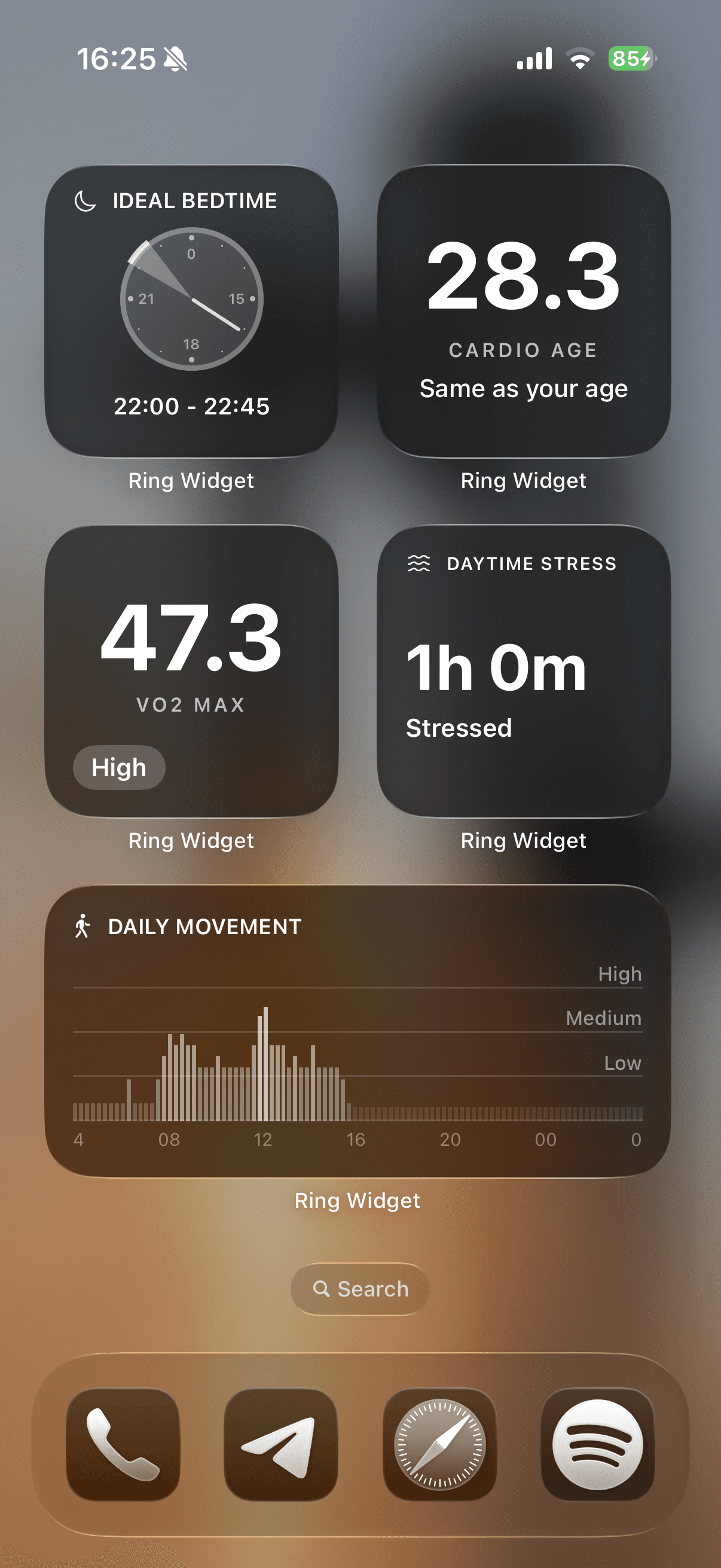
Connect Oura in Ring Widget, open the iPhone widget gallery, and choose a VO2 Max layout under Ring Widget. Our Home Screen setup guide walks through the steps. Apple controls refresh timing, so the widget is not a live measurement.
Download Ring Widget free. Readiness and Sleep widgets are free; the VO2 Max widget is part of Premium.
Frequently asked questions
What is a good VO2 max on Oura?
One in the High or Peak level for your age and sex. Oura's rule of thumb is that landing in High or Peak for your group signals strong cardiovascular fitness. For a 40–44-year-old, High starts at 32 for women and 39 for men. Oura's VO2 max reference values
Is Cardio Capacity the same as VO2 Max?
Yes. Cardio Capacity is Oura's name for its VO2 max estimate. Oura's October 2026 update calls the automatic version VO2 Max, "formerly known as Cardio Capacity." Oura's announcement
How do I get automatic VO2 max on Oura?
Turn it on in Oura Labs from the menu on the Today tab. You need a Gen3 or later ring, an active membership, at least 30 days of Oura data, and five outdoor walks, runs, or hikes recorded with GPS. Oura Labs
Can I see my Oura VO2 max without opening the Oura app?
Yes, with a widget. Ring Widget, an independent app that is not affiliated with Oura Health Oy, shows your latest Oura VO2 max on the Home Screen, Lock Screen, or Apple Watch as a Premium widget.
Sources
- What Is VO2 Max & How Is It Measured? — Oura Blog
- Cardio Effort and Automatic VO2 Max — Oura Blog
- How to Improve Your VO2 Max — Oura Blog
- Cardio Capacity (VO2 Max) — Oura Member Care
- Oura Labs — Oura Member Care
- Cardio Effort — Oura Member Care
- Heart Health at Oura — Oura Blog